


Mediation vs. Arbitration: Which Is Right for Your Business Dispute?


By Linda Alle-Murphy, Esq. and Jacob Gilbert, Esq. • October 5, 2026

TL;DR: Mediation is a voluntary negotiation guided by a neutral mediator, and nothing is decided unless both sides agree. Arbitration usually ends in a binding decision made by the arbitrator. If both parties are willing to compromise, mediation is typically faster and far less expensive. If one side won't participate in good faith, or you need immediate injunctive relief, arbitration or litigation is the better path.

When a business dispute can't be settled with a phone call, the next question is often mediation vs arbitration. A lot of the time, the answer is already written into the dispute resolution clause of your contract. When it isn't, the path you choose affects what you'll spend, how long it takes, and who gets the final word. Our business litigation attorneys help clients make that decision based on where the dispute actually stands, not on which option sounds more serious.

Here is how attorneys Linda Alle-Murphy and Jacob Gilbert approach it with clients.

What Mediation Involves

Mediation puts both sides in a room (or on a call) with a neutral professional, the mediator. The mediator doesn't decide who wins. Their role is to keep the conversation moving, help each side see its position realistically, and guide the parties toward a resolution they can both accept.

That makes mediation especially useful when a dispute has become personal. In situations where business partners have stopped speaking, a long-time vendor relationship has soured, or a customer feels wronged, a neutral voice can lower the temperature enough for a deal to happen.

"When emotions are running high, I generally prefer mediation because it allows the parties to work with a neutral professional who understands how these disputes often play out and can help facilitate a resolution."

( Linda Alle-Murphy, Esq., Litigation Attorney at Company Counsel LLC)

What Arbitration Involves

Arbitration works more like a private trial. Each side presents its case to an arbitrator, who weighs the evidence and issues a decision. In most cases that decision is binding, so the outcome is out of the parties' hands once the process starts.

Arbitration is more formal than mediation and usually takes longer, but it does deliver a final answer. That can be valuable when negotiation has already failed and the business needs the matter closed.

The Biggest Misconception About Mediation vs. Arbitration

Many business owners assume a mediator hands down a decision the same way a judge or arbitrator would. That isn't how it works. Mediation is entirely voluntary, and nothing is settled unless both parties agree to it. If you walk out of mediation without an agreement, you haven't lost anything except the time and the mediator's fee.

Arbitration is the opposite. It typically results in a binding decision made by the arbitrator, whether or not either side likes it. Knowing which of the two you're agreeing to matters, because one keeps control with you and the other hands it to someone else.

Cost and Time Compared

Both processes cost money. In mediation, the parties pay the mediator. Even so, mediation is often significantly less expensive than arbitration once you add up everything arbitration involves: arbitrator fees, attorney's fees, and the extra time it takes to see the case through to a final decision.

Time is its own cost. The longer a dispute runs, the more attention it pulls away from running the business. A dispute that settles in mediation spares the business a long proceeding.

The Factor That Matters Most: Willingness to Compromise

When Jacob advises a client on which path to take, one question outweighs the rest.

"The most important factor is whether both sides are genuinely willing to compromise. If there is room for negotiation, mediation can be an efficient and cost-effective solution."

( Jacob Gilbert, Esq., Associate Attorney at Company Counsel LLC)

If neither side is prepared to move, mediation becomes a formality, and the parties are better off choosing a process built to produce a decision.

When Mediation Won't Work

Mediation is often ineffective in two situations. The first is when one party refuses to participate in good faith. A mediator can guide a negotiation, but can't force anyone to negotiate. The second is when you need immediate injunctive relief, meaning an order that stops the other side from doing something right now. Mediation has no way to deliver that.

In those cases, arbitration or litigation is usually the better path. If you're unsure whether your dispute has reached that point, our guide on when to hire a business litigation attorney walks through the warning signs.

How Your Contracts Can Decide This in Advance

The easiest time to choose between mediation and arbitration is before any dispute exists. For contracts that don't already address it, we generally recommend a tiered dispute resolution clause. It requires the parties to try good-faith negotiation first, then mediation, and only then move to arbitration or litigation.

A few other provisions are worth adding at the same time: venue (where a dispute will be heard), governing law (which state's law applies), and attorney's fees (who pays if it ends up in a proceeding). Clear language on each of these helps avoid unnecessary fights later. A contract lawyer can build these terms into your standard agreements, and if it's been a while since you looked at yours, here's how often you should review your contracts.

Key Takeaways

  • A mediator helps you negotiate. An arbitrator decides for you.
  • Nothing in mediation is final unless both sides sign off on it.
  • Once you count arbitrator fees, attorney's fees, and time, mediation usually costs far less.
  • If the other side won't negotiate in good faith, or you need an immediate order, skip ahead to arbitration or court.
  • A tiered dispute resolution clause, plus clear venue, governing law, and fee terms, settles the question before a dispute starts.

Talk Through Your Options With Company Counsel

Every dispute is different, and the right path depends on your contracts, the relationship, and what you need out of the outcome. If you're facing a business dispute or want your contracts to handle this question in advance, schedule a consultation with Company Counsel.

About the authors: Linda Alle-Murphy, Esq. is a litigation attorney at Company Counsel LLC focused on business litigation. Jacob Gilbert, Esq. is an associate attorney at Company Counsel LLC focused on employment law and small business litigation matters.

Business at Risk?

Core business assessments that keep legal and operational risk visible


SHARE THIS

Latest Posts

Two business professionals reviewing a letter of intent document at a conference table
By Jon Thielen, Esq. • September 28, 2026
What is a letter of intent in a business sale? Learn what an LOI covers, which parts are binding, and how to protect yourself before you ever sign one.

Two business professionals shaking hands over a signed asset purchase agreement in a law office
By Jon Thielen, Esq. • September 22, 2026
Asset sale vs stock sale: the structure shapes your taxes, risk, and net proceeds. Learn how each works so you can plan a sale that protects your value.

A small business founder and an attorney reviewing fundraising documents together at a conference table
By Jon Thielen, Esq. • September 22, 2026
Raising capital soon? Learn the legal steps, from securities basics to term sheets, that keep your fundraise clean and protect your ownership as you grow.

Attorney and business owner reviewing an employment classification agreement at a desk
By Jacob Gilbert, Esq. • September 20, 2026
Employee vs independent contractor: getting it wrong is costly. Learn how classification really works and how to protect your business from penalties.

Person in a blue suit signing a document at a desk with papers and a pen.
By Bernard A. Williams, Esq. • July 27, 2026
Non-compete rules are changing fast. Learn whether non-compete agreements are still enforceable for your business and what to use to protect it instead.

Colleagues reviewing documents together at a conference table.
By Bernard A. Williams, Esq. • July 20, 2026
Who runs your business if you step away? Learn how business succession planning protects your legacy, your family, and the value you have worked to build.

Manager shaking hands with a new hire at a desk in an office.
By Bernard A. Williams, Esq. • July 13, 2026
Hiring your first employees? Learn the legal requirements, from classification to handbooks to paperwork, that protect your business as you build a team.
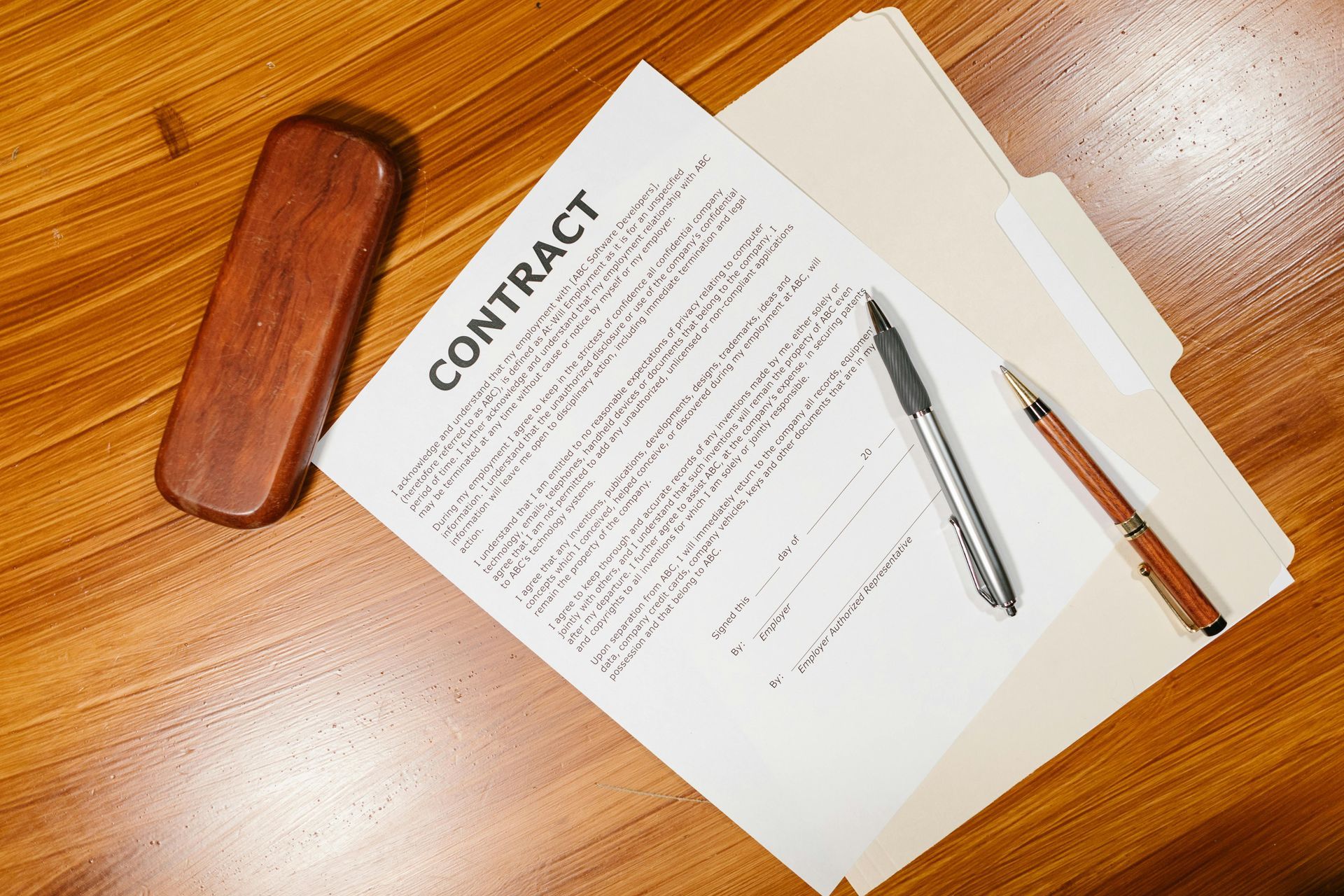
Contract document on a wooden table next to a pen.
By Bernard A. Williams, Esq. • July 6, 2026
The most expensive contract is the one you never reviewed. Learn how often to review your contracts and which clauses to check as your business changes.

Brown envelope stamped STARTUP in front of a laptop on a desk.
By Bernard A. Williams, Esq. • June 29, 2026
Starting a business? Here are the core legal documents every new business needs, from formation and contracts to IP and HR, to build on a solid foundation.

Gavel on a wooden table with a person typing on a laptop and documents.
By Bernard A. Williams, Esq. • June 22, 2026
Weak contracts and unclear ownership cost you at closing. Learn the legal issues that reduce business value, and how to fix them well before you sell.
Show More